
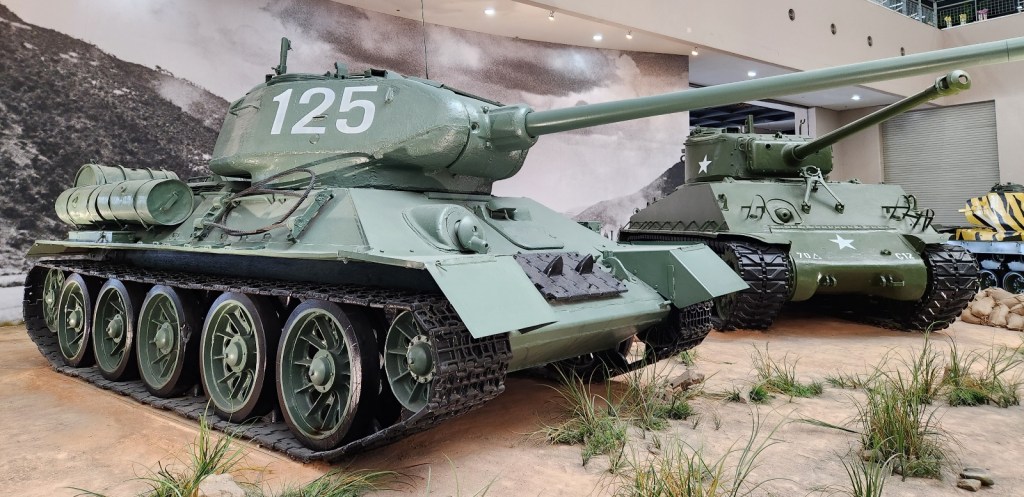
A T-34-85 and M4A3E8 “Easy Eight”
These two tanks are currently on display at the Yongsan Korean War Memorial Museum. They have a wide display of Korean War-related armoured vehicles, artillery pieces, and aeroplanes.
Which of these WWII icons will come out on top?
Context
The first time these two World War II icons came to blows was during the Korean war, which was initiated by a surprise attack on June 25th, 1950, when Soviet-backed forces under North Korean dictator Kim Il-Sung invaded South Korea. Lacking both weaponry and manpower, the South was pushed back rapidly, with the capital, Seoul, falling to the North just three days after combat commenced. The South would be clinging on grimly to just the southernmost tip of the peninsula, near Busan, by the time NATO forces arrived to their aid.
Introduction
T-34-76 Model 1941
Above is an example of an earlier iteration of the T-34, featuring the smaller turret and less powerful 76.2mm main armament. The T-34 would receive the larger cast turret, used in the T34-85, in 1943.
The T-34, first introduced in September of 1940, was produced by the Soviet Union in response to the Panzer IIIs and IVs of the German Wermacht, which had seen great success using rapid Blitzkrieg envelopment tactics with their medium tanks. Initially mounting a short-barrelled, low-velocity 76.2mm ZIS-5 gun, its main armament would in late 1943 be upgraded to the far more powerful long-barrelled, high-velocity 85mm ZIS-S-53 anti-tank gun in order to counter the heavier German armour of the Panther (Panzer V) or Tiger (Panzer VI) tanks it could be expected to face. It was this iteration of the T-34 that was loaned to the North Korean army by the Soviets, although the weaker 76mm-gun-armed T34 also saw action in the invasion.

M4A1 Sherman
This is the first and earliest variant of the Sherman. Note the fully cast hull, with curved edges, as well as the smaller turret and low-velocity 75mm gun. Both the gun and the lower section of the hull were borrowed from the older M3 in an effort to accelerate the M4’s development.
The M4 Sherman saw similarly extensive service during the Second World War, and was also developed in response to the success of the German Panzers in Europe and East Africa. Noting the ineffectiveness of the M3 Lee and Grant medium tanks during the East Africa campaign, the M4 Sherman was developed on the M3 Lee chassis, mounting the latter’s 75mm M2 armament in a centrally-mounted turret, rather than an offset sponson, in a more conventional layout. The Sherman first saw action in the Second Battle of El Alamein in 1942.
Throughout the war, both tanks saw improvements made to their armament, armour, and mobility, as both sides sought to maximise the combat lifespan, effectiveness, and production cost of their primary workhorses. The final iteration of the Sherman, the M4A3E8 “Easy Eight,” would mount the high-velocity 76mm M1 anti-tank gun and rec eive both armour and suspension upgrades over its predecessors, bringing its mobility and firepower on par with its contemporaries.
Korean War Combat History
The Easy Eight M4 and T-34-85 were the most prominent medium tanks of their day, and the warhorses of their respective countries. As such, they both played a key role in the mechanised land operations in the Korean War. The 105th Armoured Brigade served as the breakthrough unit for the North Korean mechanised advance, and featured heavily with T-34-85s; the 105th continues to be the elite armoured division of the DPRK’s Korean People’s Army (KPA) to this day.
During the Korean War, the M4A3E8 Easy Eight was the main tank of the U.S. military until the signing of the armistice agreement, as it was considered the most versatile, most readily available, and most fitting counter to the T34. The U.S. Far East Command collected 58 M4A3E8 scattered throughout Japan, created the 8072nd Temporary Tank Battalion (later renamed to the 89th Tank Battalion) on July 17 and landed them in Busan on August 1. A total of 679 Easy Eights would be serving on the peninsula by 1950, compared to anywhere between 800 and 1200 T34-85s.
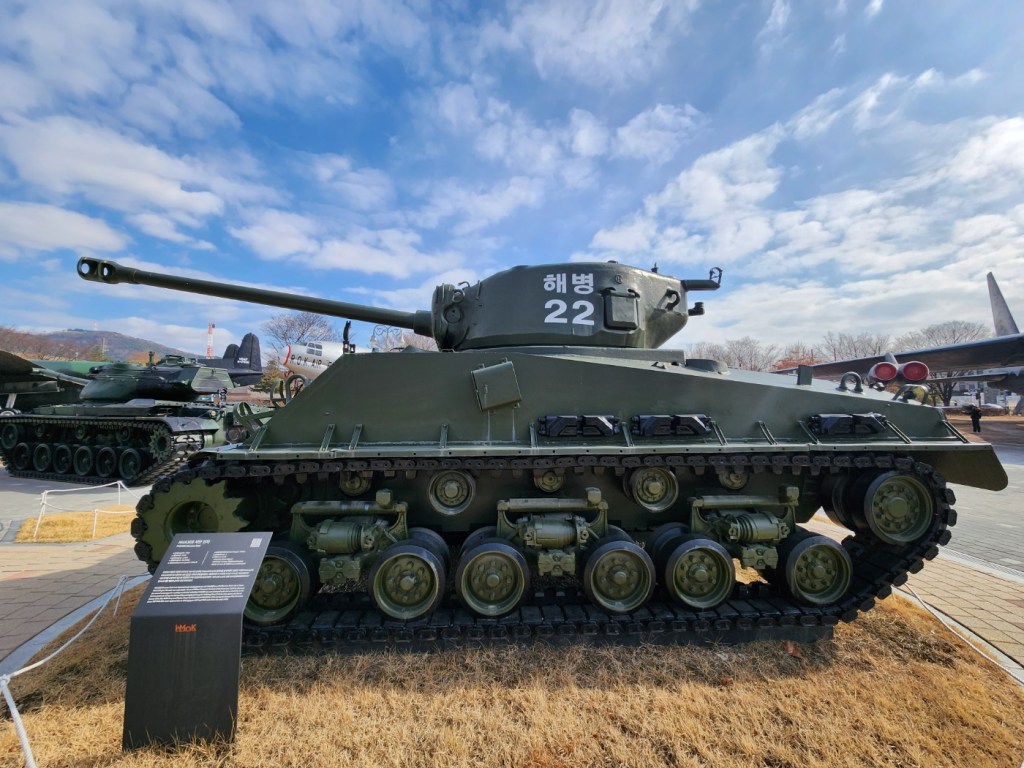


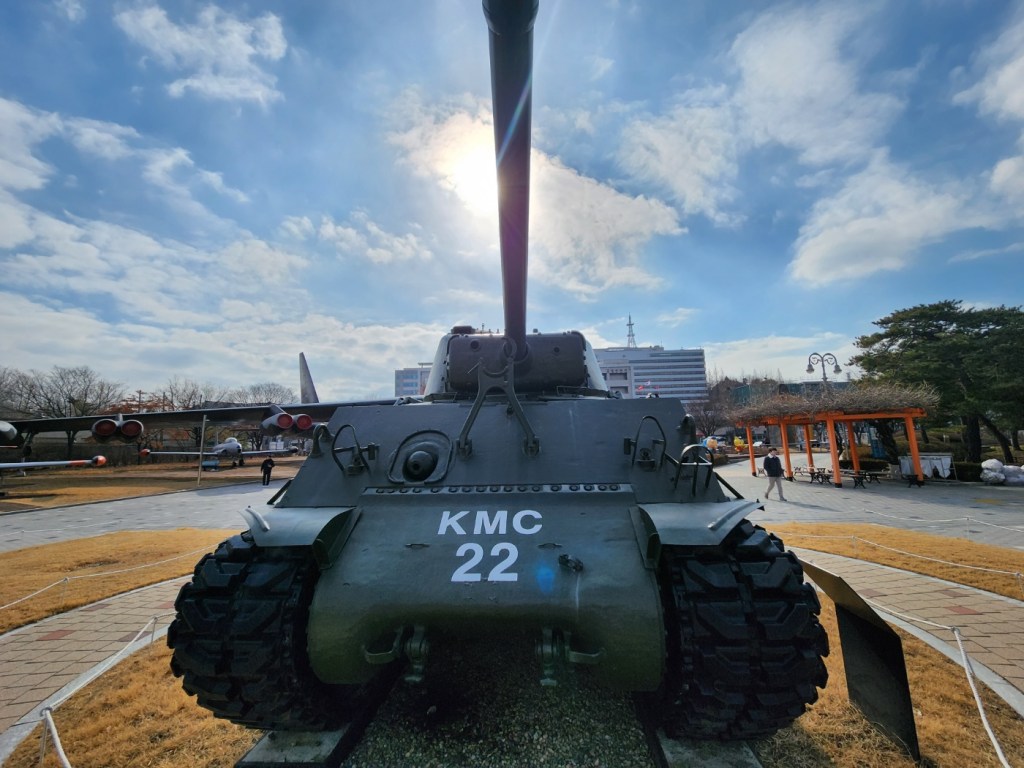
Comparisons
In order to assess which of these two iconic warhorses was in fact the superiour tank, I will use some standardised metrics. For all these examinations, I will assume that both tanks are at full combat capacity and in their final iterations (T34-85 Mod. 1946 and M4A3E8).
Firepower

M4A3E8
The Easy Eight mounted the 76mm M1A2 anti-tank gun Mod. 1943. Using the Tungsten-core Armour Piercing Composite Rigid (henceforth APCR) round, the Eight was able to penetrate 146mm (5.7 in) of rolled homogenous armour plate (RHA) at a range of 1000 metres. Ammunition capacity ranged from 83 to 71 rounds, depending on loadout, and the APCR shells had a maximum velocity of 1036 m/sec. The M1A2 gun was accurate to a range of 2500 metres, and the relatively small calibre of shell meant that the ammunition was comparatively light, facilitating a quick rate of fire.
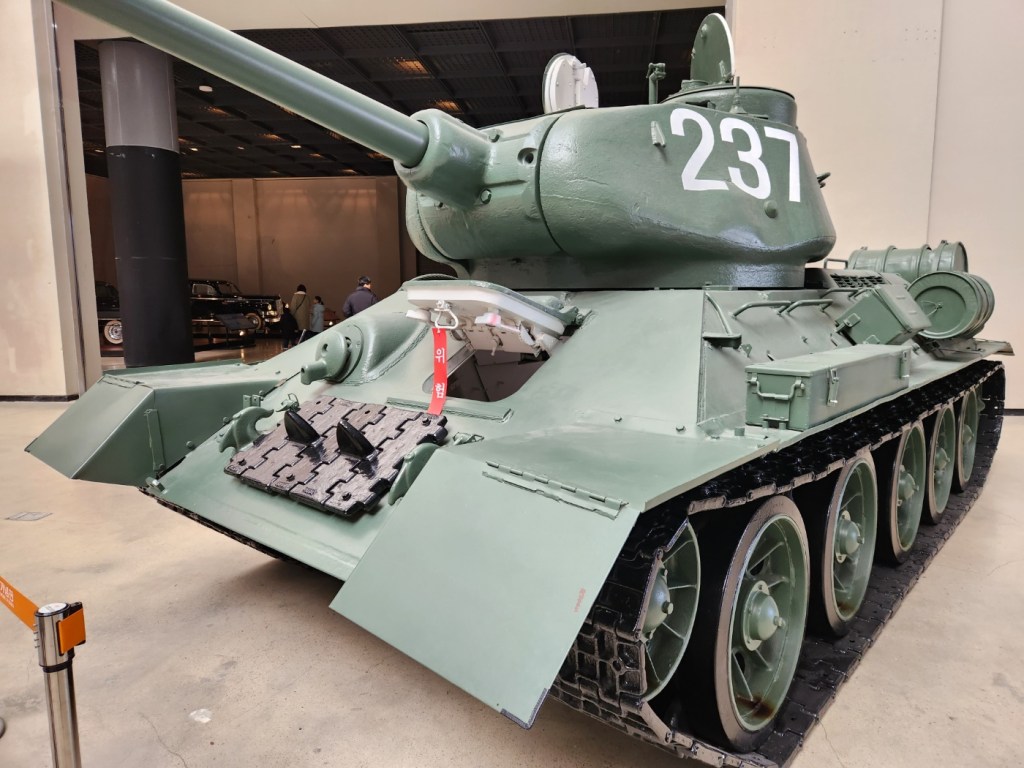
An angled T-34
From this front angle, the plates are all slanted backwards and at a tangent from the direction of incoming fire. Experienced commanders would attempt to position their T-34s in such a way to maximise the effective armour thickness of their tank, and to encourage any incoming shells to bounce off of the steeply angled sides or front hull.
T-34-85
Initially, the first T-34-85s mounted the 85mm D-5T anti-tank gun, which had inferior ballistics to the ZIS-S-53. The latter was longer, 55 calibres versus 60, and also enjoyed better muzzle velocity from the same shell as a result. The ZIS-S-53 was able to penetrate 134mm (5.3 in) of RHA plate at a range of 1000 metres using its APCR ammunition, with a maximum velocity of 1050 m/sec. The ZIS was accurate to a range of 2250 metres, but penetration values deteriorated rapidly past the 1700-meter-mark, with penetration with APCR falling to a mere 95 at 1500 metres. As a result, its preferred maximum range against contemporary tanks in combat was around 1200 to 1700 metres.
Verdict
This one is difficult to call. The Easy Eight has marginally better penetration and a greater effective range than the Soviet, but the T-34 enjoys higher shell velocity and a better HE shell, as the larger 85mm round could fit more TNT charge simply by virtue of being larger and heavier than its 76mm American counterpart. Moreover, the Easy Eight could carry roughly the same amount of ammunition as the T-34, and both tanks had similar accuracy. However, the better fighting compartment ergonomics and better optics of the M4 likely helped it achieve more consistent hits on target at range.
In a brawl, the bigger calibre of the T-34-85 might prove decisive; at range, the superiour ergonomics and optics of the M4, coupled with its higher penetration, would likely give the American the edge. A tie, then.
Survivability

M4A3E8
The Easy Eight came a long way from the antiquated cast hull of the original M4. Multiple iterations saw the M4 hull up-armoured, with the M4A3E2 Jumbo variant bolting 1.5 inch-thick steel plates on the sides and front panels. The Easy Eight maintained the armour profile of the Jumbo, with a 102mm (4.0 in) front plate angled backwards at 40 degrees, resulting in an effective armour thickness (EAT) of 180mm (7.1 in). Its sides were 76mm (3.0 in) thick, and relatively unangled.
The turret of the Easy Eight was borrowed from the larger T23 medium tank, and thus was larger and better armoured. The turret front, including the mantlet, was protected by 130mm of armour, with 76mm on the sides and rear.
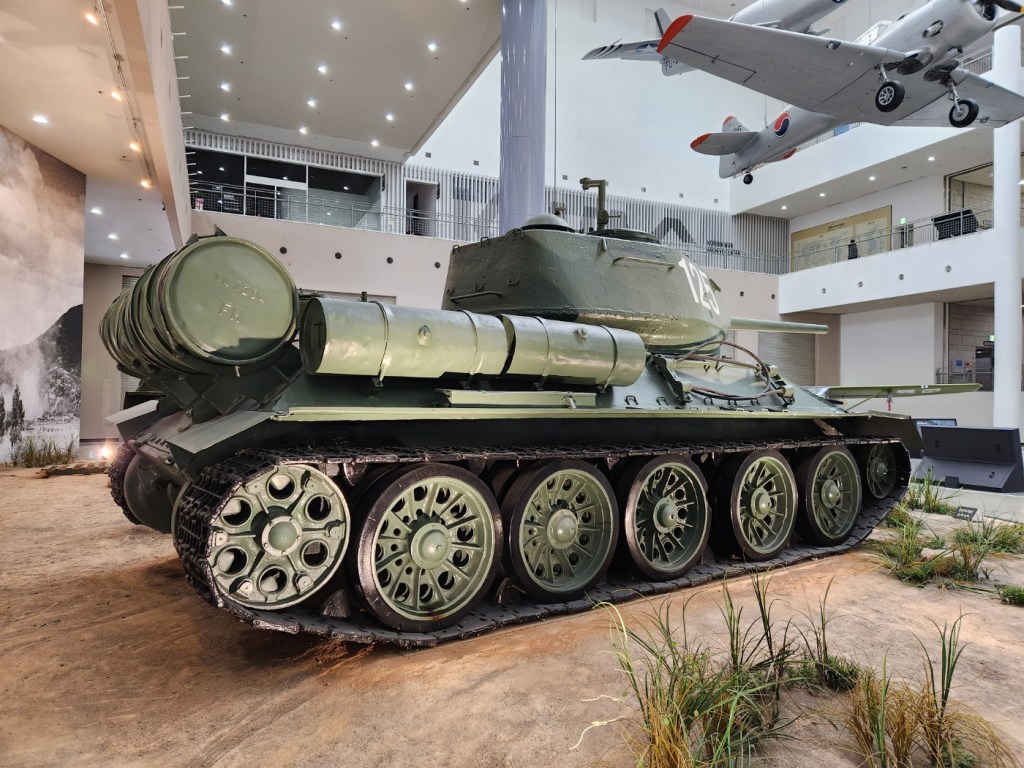
T-34-85
The T34’s hull remained relative unchanged from its inception in 1941. The front hull was protected by 45 mm of armour, sloped at 60 degrees from the vertical, giving an effective frontal thickness of 90 mm (3.54 in), while the sides and rear had 45 mm (1.77 in) at 45 degrees of sloping. The turret face and mantlet were 90 mm (3.54 in) thick, with 75 mm (2.95 in) sides and 52 mm (2.04 in) at the rear.
Verdict
Here, the verdict is more certain. The numerous iterations of armour improvements greatly enhanced the M4 during the course of its service career, while the Soviet’s fixation on mass-production and minimising costs left the protection of the T-34 largely untouched, with only marginal changes designed to streamline production rather than better protect the tank. With thick armour, similar levels of sloping, and a significantly better-protected turret, the M4A3E8 takes a decisive win in the survivability department.
Mobility
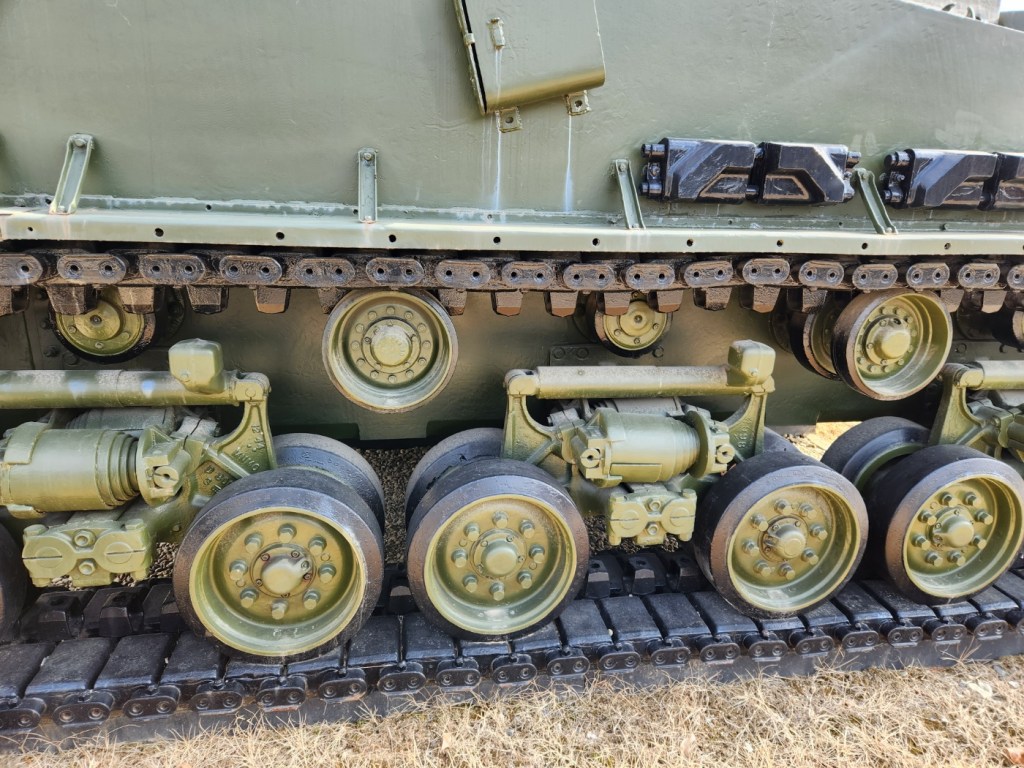
The suspension system of the Easy Eight
All M4 variants used a type of these volute spring suspension bogies. Volute springs were chosen because they can bear more weight than convention springs; volute spring coils fit into each other, like concentric rings, and therefore the spring can collapse to a smaller height before bottoming out. However, these 2-wheel bogies could be unstable, and did not provide for good impact absorption over rough terrain.
M4A3E8
The Easy Eight used the Ford GAA V8 gasoline engine, producing 500bhp and 1000 lbs-ft of torque at 2600 rpm and displacing 18 litres. The tank’s specific power was roughly 14hp/tonne, and was renowed for its respectable off-road abilities. In comparing the M4 to contemporary British medium tanks, the Cromwell and Centaur, the presiding British officer remarked that “they [the M4s] appear so infinitely superior in reliability with a minimum of maintenance.”
The maximum speed of the M4 offroad was roughly 20mph, although this was subject to variables of the softness of the terrain, the type of ground, prevailing weather conditions, etc. It could potentially reach speeds up to 30mph on hard, flat terrain. Its operational range was 250 to 300km, depending on loadout and terrain conditions.
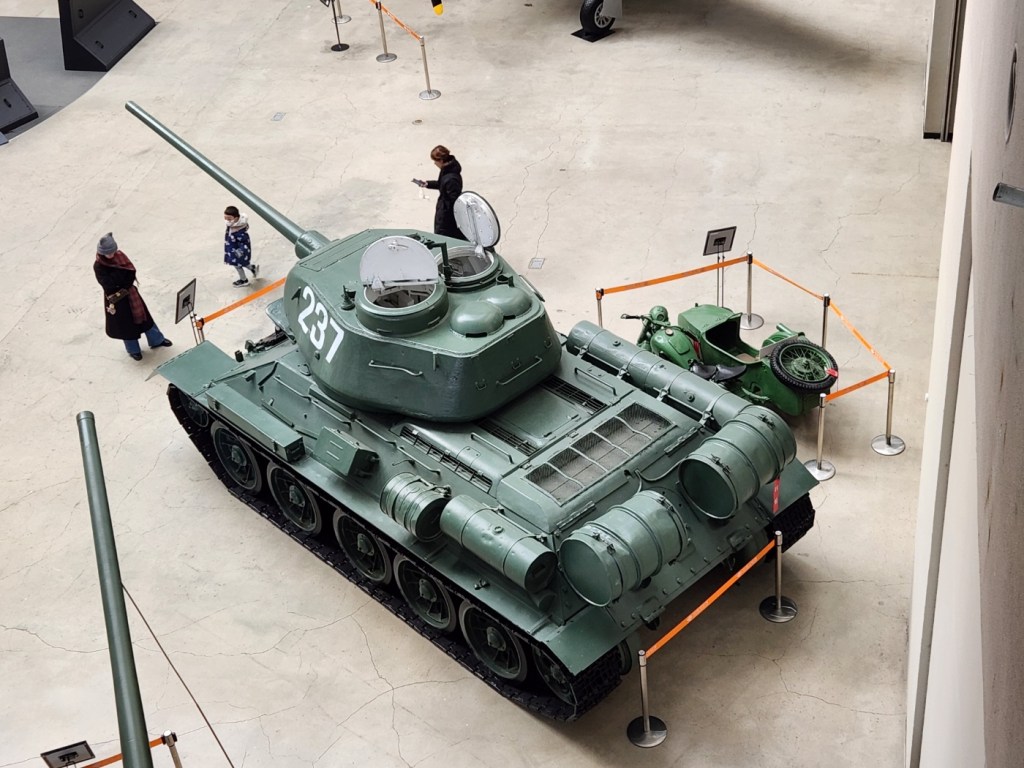
T-34-85 Aerial View
The T-34-85 from an aerial view. Note the massive external fuel tanks for extra range, as well as the large vent grilles at the back to cool the massive 38.8-litre engine.
T-34-85
The T-34-85 used a diesel V12, the Kharkiv Model V-2-34, producing 550bhp and 1500 lbs-ft of torque at 1600 rpm. The diesel motor displaced 38.8 litres, and offered near-unbeatable acceleration to a relatively light medium tank that scarcely weighed 30 tonnes. Even with such a large motor, the T-34 had an operational range of 330km, and using the two 95 litre fuel cans at the rear, it could extend that range to nearly 500km.
The T-34’s wide and flat tracks were designed to work best on frozen, icy terrain. On hard ground, the Soviet medium could expect to achieve speeds of up to 35 mph, and 25mph offroad. One downside was that the track design was unfavourable for muddy conditions, where the wide and flat tracks often bogged the tank down and caused it to get stuck.
Verdict
On mobility, the light Soviet medium makes up ground (pun intended) on the heavier, but less nimble, American. The T-34-85s massive (nearly 40 litre) engine powers it faster and further than the M4A3E8, and gave it a specific power rating of nearly 18. The Soviet was had a diesel engine, as opposed to petrol, and thus enjoyed more torque at a lower rpm, which assisted in towing or in navigating difficult terrain. A win for the T-34-85, here.


 Motor History Korea
Leave a comment