
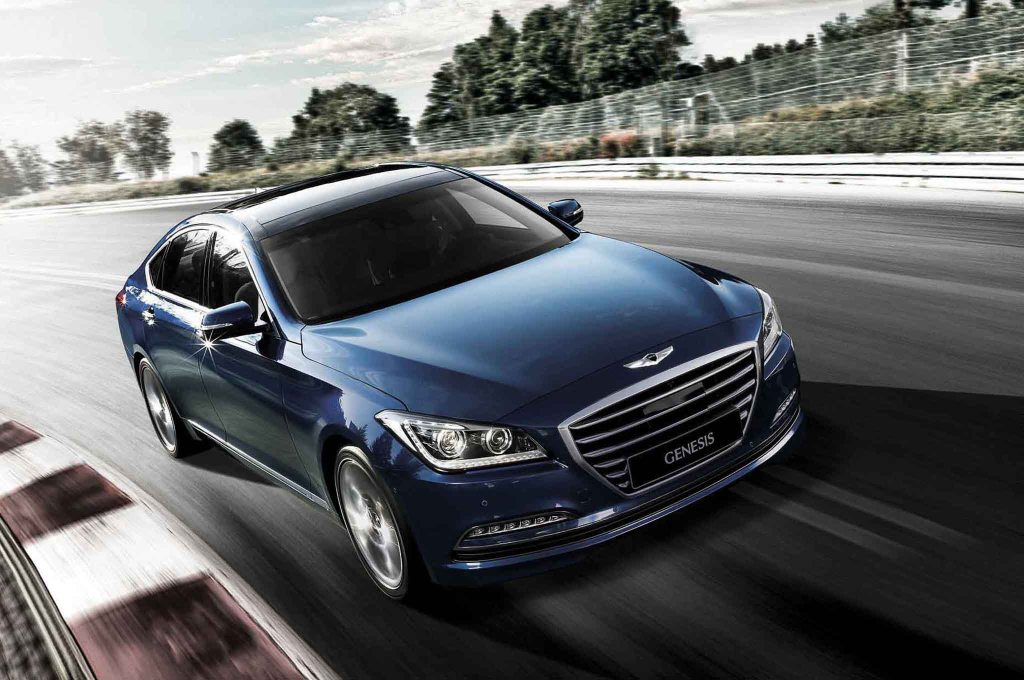
“Good artists copy. Great artists steal.” Those are words from Pablo Picasso, and he most certainly has made his case for membership to the latter. But it’s true. The best creative minds don’t always come up with a revolutionary concept, and when they do, it is always snapped up, repurposed, rebranded, and re-sold by the competition. And so turns the creative wheel of competition. As in art, so too with automobiles.
To me, the rise of Genesis has always been a story of second options. We profile brands by the drivers they attract and the people they embody; we might not know anything about the driver of an Aston Martin, and yet parallels are drawn to the black-tie glamour of Connery nonetheless. The Genesis driver, by contrast, is someone who could have had a BMW or Mercedes or even an Audi, but decided to buy a car from his home country, at a bargain compared to the offerings of (notably superiour) German counterparts. He buys a Genesis because it is better value for money than an E-class, has better fuel economy than a 5-Series, and looks better than an ES-350.
The design of Genesis models is yet again reminiscent of great European marques; the shield-shape grille is somewhere between Alfa Romeo and Lancia, while the decorative vents behind the front wheel arches are most definitely Maserati or Aston-derived. Their flagship luxury SUV, the GV80, was penned by the same designer of the Bentley Bentayga, Luc Donkerwolke (a protege of one Chris Bangle), and one cannot help but think he did so with a sheet of tracing paper in one hand and a ruler in the other. The Genesis saloons are yet again competitors to the sporty offerings of Munich and Stuttgart, and their designs reflect this role as a bargain alternative.
Except now, they aren’t bargain alternatives anymore. The flagship Genesis saloon, the G90, now commands north of 120k USD fully loaded, which sets it firmly into BMW 7 Series and Audi A8 territory; and its interiour has the luxury to match. The new Genesis Magma label promises a more performance-oriented line for its existing cars, akin to the M and S badges of BMW and Audi, respectively. Somehow, they’ve managed to steal the philosophies and marketing strategies from their more upmarket counterparts, and it has been so successful as to bring Genesis closer and closer to parity.
This is especially interesting to me because, from a historical perspective, Korean car labels were considered inferiour to Japanese and American offerings, let alone the prestigious marques of continental Europe. And while Kia and Hyundai have remained on par with Toyota and Ford as automakers for the common people, the Genesis luxury brand has somehow emerged from the shadow of the Germans and British to become something that even the discerning consumer could realistically consider. Of course, they are cheaper than the Germans still, and not as luxurious as the British; it will be at least a decade before a Genesis is regarded in the same clique as a Range Rover or Jaguar. However, the movement and improvement is there, as is a growing consumer base of young millenials who seem to eschew the traditionalism of the establishment for the newfangled bargain or technologically innovative. If Tesla’s build quality wasn’t enough to dissuade the young’uns, I doubt that Genesis’ lack of heritage will, especially not considering the price gap between a G70 and an equivalent Audi A6 40 TDI. Somehow, most of the public just doesn’t care, and so Genesis can simply copy the notes of the Germans and Brits on how to set up a successful luxury car brand, and they are arguably doing it better.
I like Genesis, not just because it is from my home country and built by my countrymen, but because it symbolises the rise of the South Korean nation in the eyes of the world. Of course, we had to copy and steal from nations who knew better than us. The Toyota 2000GT, lauded as one of the most beautiful cars in the world (as well as one of rhe most successful cars in motorsport back in the 60s) was a result of shameless copying of chassis blueprints from Lotus and Jaguar. The Mazda 787b raced with an engine design taken from a German, and Lexus engineers tore apart a contemporary S-class before making the LS400, which famously balanced a pyramid of crystal glasses on its bonnet at full revs. In each case, ideas were taken and creative liberties lavished, resulting in some of the world’s best and most memorable cars. I can’t say for sure if Genesis will rise to the ranks of those legends. All I can say is that for all of it’s tracing-paper antics, it’s come a long way. Copycat or not, Genesis is here to stay, and if its name is anything to go by, it might just be the beginning of a new, prestigious, and decidedly lucrative chapter in Korean motoring.




 Motor History Korea